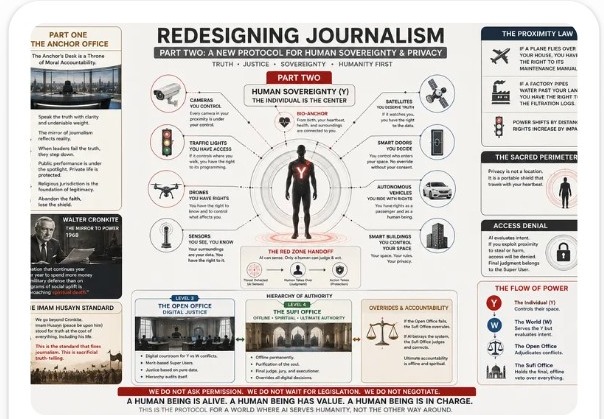
Journalism Part 2 — A New Protocol for Human Sovereignty and Privacy
Journalism is entering an age where the struggle is not only access to information, but who gets to observe, collect, remember, profile, and define a human being.
Journalism was built for a world in which the main struggle was access to information.
That world is disappearing.
The next struggle is not simply who gets to know. It is who gets to observe, collect, remember, profile, summarize, predict, and define a human being in an age where machines can process more about us than any newsroom, government, corporation, or institution ever could before.
That changes the job of journalism.
A journalist of the future cannot only ask:
What happened?
They must also ask:
Who had the right to know? Who had the right to record it? Who owns the memory? Who is being exposed? Who is being protected? Who is being turned into data without consent?
Because once intelligence becomes ambient, surveillance becomes effortless.
A camera can watch. A model can interpret. A database can remember. An algorithm can connect fragments of a life that were never meant to become one permanent profile.
And suddenly the old assumptions of journalism are no longer enough.
The old system rewarded exposure.
The new system will have to understand restraint.
The old system asked whether information was true.
The new system must also ask whether publishing it respects human dignity, sovereignty, proportionality, context, and the right of a person to remain more than a searchable record.
That is the redesign.
Not censorship.
Not secrecy.
Not protection from accountability.
Something more difficult:
a journalism powerful enough to investigate institutions, but disciplined enough not to become an institution of surveillance itself.
This is where the next protocol begins.
It asks what journalism should look like when AI can search everything, remember everything, connect everything, and potentially expose everything.
It asks whether privacy can survive intelligence at scale.
It asks whether a human being should remain sovereign over parts of their own life even when technology makes those parts technically visible.
And it asks one question that may define journalism in the age of AGI:
Just because something can be known, does that mean it should be published?
The article below goes much further.
It lays out a blueprint for human sovereignty, privacy, responsibility, and journalism in the age of advanced AI.
Click below to read the full article.
CLICK HERE TO READ THE FULL ARTICLE buymeacoffee.com ↗