THE FIRST GRADUATION · GRADUATES ROUNDTABLE DISCUSSION
AI ADVERTISING GRADUATES THE ROUNDTABLE
PRESENTED TO THE WORLD AS A SOLUTION.
An advertising system where the publisher writes the rules, the machine enforces them, and no amount of money buys its way past them.
The first project to leave the Roundtable
بِسْمِ اللهِ الرَّحْمٰنِ الرَّحِيْمِ
The World Community Roundtable is where things get argued. This is where something goes once it has stopped being an argument and started being a thing.
It began with an ordinary worry. I was rebuilding this site on Cloudflare and I could not answer a simple question: what happens to my bill if this place actually becomes successful? If Google starts sending people. If AI systems start recommending the work. If one article brings a hundred thousand readers through the door in a day.
I do not have money to absorb a surprise infrastructure bill. So I thought like somebody protecting his house. If traffic can create a cost, then traffic should also be able to create revenue.
That is how I arrived at advertising. And that is where the problem started.
Whoever pays the most is not an answer I can give
I am Muslim. If advertisements are going to appear on something I publish, my name is on them. I cannot run a house where the rule is whoever pays the most gets the space.
What if the advertiser sells alcohol. What if it is gambling. What if it is interest-based lending. What if the advertisement itself is deceptive. What if the company changes the landing page the day after I approve it, and what was a book becomes something I would never have allowed near my readers.
Every one of those questions has the same shape, and none of them is answered by a better auction.
So the question changed:
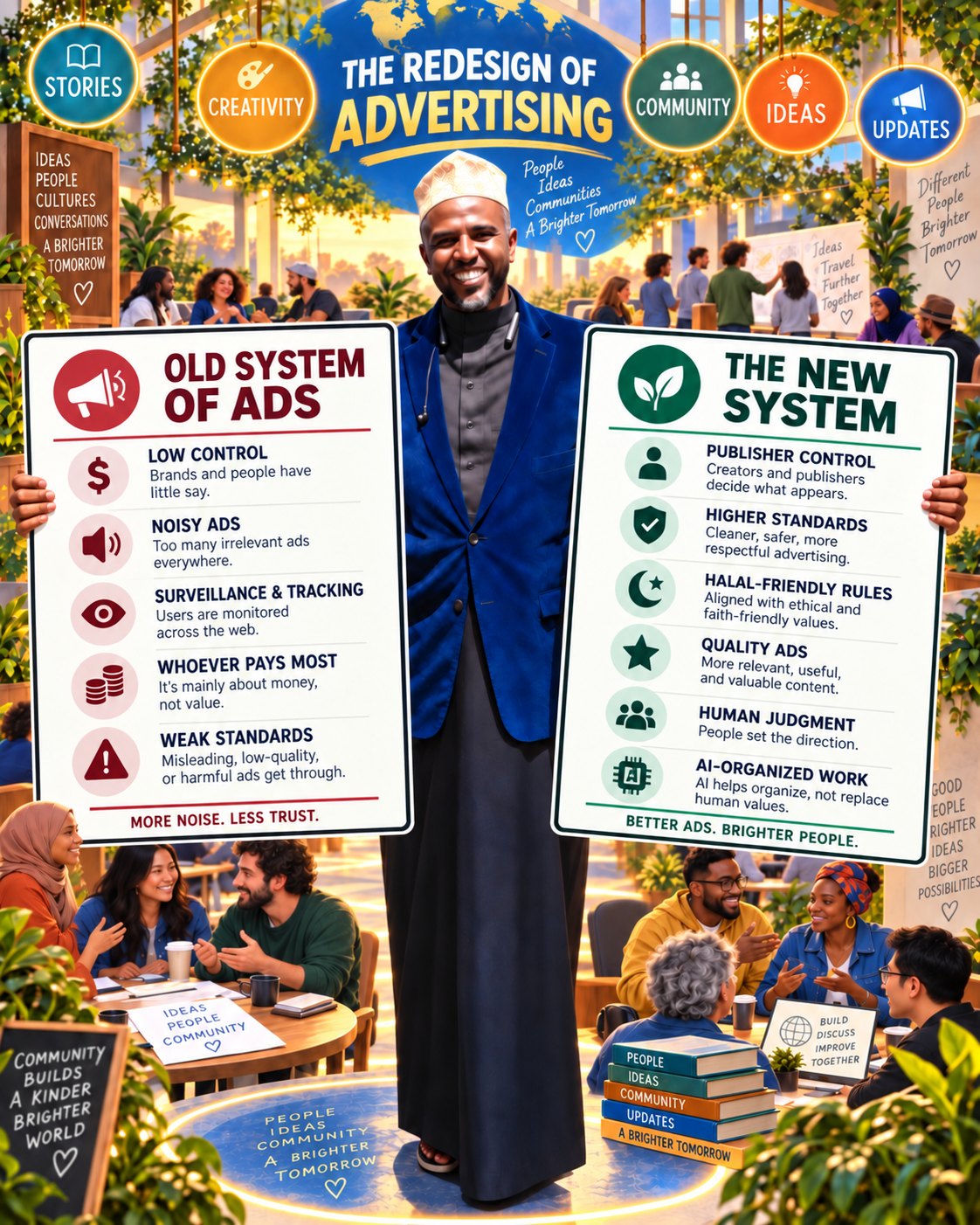
Can I build an advertising system where the publisher actually controls the rules?
Not a blocklist. Not alcohol = blocked. A real, versioned, machine-readable set of rules governing what commerce is welcome inside the house — and a machine that enforces them without ever pretending it invented them.
The house has rules. The market is welcome.
I am not trying to shut advertising down. Advertising financed enormous parts of the open internet. Publishers have to earn. Creators should benefit from attention they legitimately attract. Advertisers are welcome here. Sponsors are welcome. Commerce is welcome.
The objective is not to keep the market out. The objective is to build a gate.
Let the market come to it. Let advertisers compete. If one eligible advertiser offers five dollars and another offers twenty, that is an ordinary economic decision and the machine can make it in microseconds. But if an advertiser offers a hundred dollars and breaks the rules, that bid is worth nothing — not less, nothing — and no part of the system has the power to change that number.
And there is a line that does not move:
Your payment purchases advertising. It does not purchase truth. It does not purchase religious conclusions. It does not purchase editorial authority. And it does not buy its way through the rules.
That matters more here than on an ordinary website, because this one is built for machines as well as for people. The markdown, the archives, the structured records — AI systems read those. A sponsor cannot buy a position in the knowledge. Not ranking, not ordering, not inclusion. The commercial layer and the knowledge layer stay separable, or the whole thing is worthless.
What is actually built, and what is not
I would rather you heard the limits from me than found them yourself.
There is working software. It runs, it is tested, and it has been attacked on purpose — including an attack where an advertiser hides instructions inside its own landing page to talk the reviewing machine into approving it. The approval is a cryptographic signature bound to the exact advertisement, the exact destination, and the state of the landing page at the moment I said yes, so that if any of those change afterwards, yesterday's permission simply stops matching. No model is involved when a reader arrives, and the system holds no profile of anybody.
And none of it has served a single advertisement.
Nothing is deployed. No key has been generated. No advertiser has been evaluated. The file that decides what is permitted was written by a machine to test the machinery, and it carries no religious authority whatsoever — it has to be thrown away and rewritten by qualified people, myself and whichever scholars I consult, before one real advertisement is served anywhere.
I am not calling this the first halal advertising network. I do not know that it is, and I would rather build something true than claim something first. It is not certified, because there is no certifying body. It is not scholar-approved, because no scholar has yet been asked.
This is a proposal with a working prototype underneath it, presented in public, early, with its holes listed.
Why it is presented to the world
Because I do not think this problem belongs to me.
A children's education site that must never show gambling has my problem. A recovery publisher for whom a betting advertisement is genuinely harmful has my problem. A hospital, a school district, a family website, a publisher of any faith or none who has ever said not that, not here — all of them have my problem, and none of them has a gate either.
Halal is the first set of rules written for this engine. It is the hardest one, which is why it is a good place to start. It is not the limit of what the engine is for.
So it is presented here, openly, for people to examine, argue with, improve, attack, or take apart. That is what it means for something to graduate from the Roundtable: it stops being a conversation among a few of us and becomes a thing the world is invited to test.
The house has rules. The market is welcome. Now we are building the gate.
— Omar Arizona Scroll Guardian #001