AI ADVERTISING GRADUATES THE ROUNDTABLE
AI Changes Everything. The Old Measuring Stick Is No Longer Enough.
Advertising was built for an internet where only corporations had intelligence. When the individual finally has an AI of his own, the whole arrangement has to be reconsidered — and this is the starting story, not the destination.
I want to put a new idea on the table.
Not because advertising did not exist before me.
Not because nobody has ever tried halal advertising, contextual advertising, privacy advertising, or publisher-controlled advertising.
They have.
My argument is different.
AI changes the conditions underneath all of them.
The old advertising industry was built for an internet where corporations had the intelligence, the data, the servers, the advertising departments, and the ability to follow millions of people.
The individual had almost none of that power.
That is changing.
And when the individual finally has an AI of his own, advertising itself has to be reconsidered.
We need a new starting story
Everything starts with a story.
My story started last night with something small.
I was worried about my website.
If OmarArizona.com suddenly receives huge traffic, what happens to my infrastructure costs?
Could success itself become expensive?
So I started thinking about advertising as a backup plan.
Traffic comes in.
Revenue helps support the house.
Very normal problem.
But I now have something previous generations of independent publishers did not have.
I have GPT helping me plan and expand the architecture.
I have Claude working through Dispatch and capable of engineering software.
I have Cloudflare infrastructure capable of running what the agents build.
I have Gemini.
I have DeepSeek.
And I can bring different intelligence into the same room.
So instead of asking:
Which advertising company should I install?
I asked:
Why don't I build the advertising control system I actually want?
That was the beginning.
But it is not the destination.
The moment AI enters advertising, the old map changes
For decades, advertising has relied heavily on ideas such as impressions, clicks, CPMs, demographic segments, cookies, profiles, attribution models, and platforms trying to determine who is likely to buy something.
Those measurements are not disappearing tomorrow.
But they are no longer the whole story.
Because now imagine something completely different.
Instead of only the advertiser having intelligence — the customer has intelligence too.
Instead of Google or another large company maintaining the smartest commercial picture of a person — the person can eventually have an AI agent working for the person.
That changes the marketplace.
This is where BCS enters
People following my work already know I have been developing the Brand Currency System — BCS.
BCS is the other side of this advertising story.
Advertising deals with attention and discovery.
BCS deals with what happens when products actually move through the economy.
Brands. Products. Wholesale. Retail. Consumers. Purchases. Receipts. Coupons and offers. Feedback. Value. Transactions.
Now put AI between those pieces — but put it there for the individual, with the individual's knowledge and permission.
That is where things become interesting.
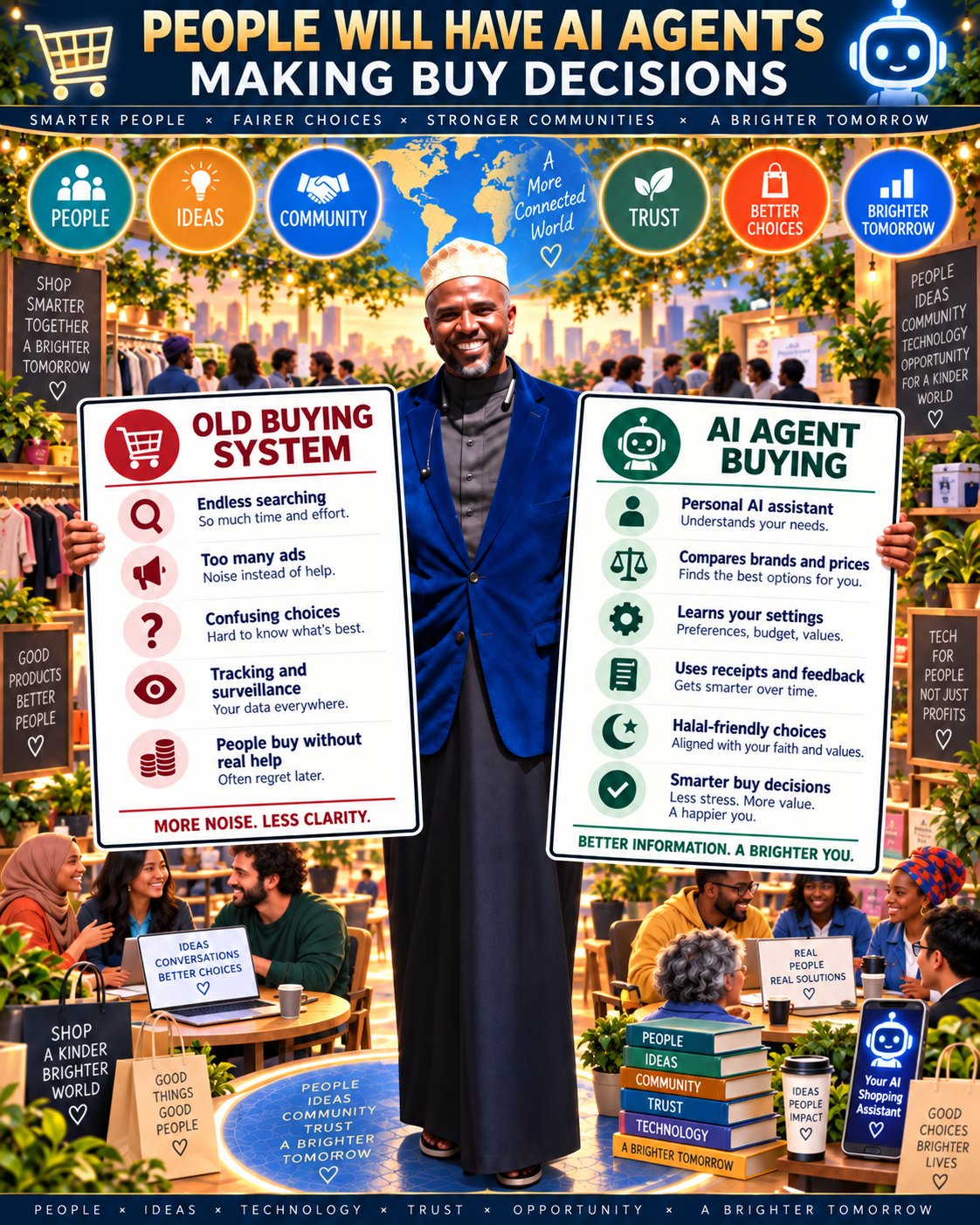
Stage one: the individual gets a commercial AI
Imagine your own private commercial agent.
Not an invisible advertising profile somebody else built about you.
Your agent.
You decide its settings. You decide what information it can use. You decide what categories matter. You decide what you never want advertised to you.
For a Muslim, those settings could include halal requirements. Another person could have completely different settings.
The agent could understand the products you voluntarily connect to it. Your receipts. Products you actually purchased. Brands you interact with. Offers you accepted. Things you rejected. Feedback you chose to give. Things you want to buy next. Businesses you trust. Businesses you do not want.
And the important word is:
CONSENT.
The information is not secretly collected to build a shadow version of you for somebody else's advertising machine.
The intelligence works on your behalf.
That reverses the relationship.
The old model watched the person
The new model can ask the person.
That is a profound difference.
Instead of:
We followed you around the internet and calculated that you might want running shoes.
your agent could say:
You told me you need running shoes. Here are five qualifying offers from brands willing to compete for your business.
Think about how much waste disappears.
The advertiser no longer has to scream at a million people hoping ten thousand might care.
The customer no longer has to surrender privacy simply to discover an offer.
The AI can begin matching real demand with real supply.
That is a different advertising market.
And the individual should have settings
This is one of the things I believe strongly.
The future consumer should have an advertising control panel.
Something simple.
YES. NO. ASK ME.
That is essentially the same GREEN / YELLOW / RED logic we started building for my website.
For me as a Muslim:
Alcohol? No. Gambling? No. Interest-based lending? No. Useful technology? Possibly yes. Books? Yes. Something ambiguous? Ask me.
Now imagine that principle applied by millions of individuals.
The advertiser does not have to guess the standard.
The standard is machine-readable.
That is not only better ethics. It can become better market information.
The physical world and the online world now connect
This is why BCS matters so much to this idea.
Advertising has traditionally struggled to connect the message to what actually happened afterward.
But imagine an AI ecosystem where, with permission:
Advertisement → Product → Store → Purchase → Receipt → Experience → Feedback → Future recommendation
That creates a much more meaningful economic picture.
Not because some corporation secretly watched everything. Because the customer deliberately allowed their own system to participate.
Now we can begin asking completely different questions about value.
Who introduced the product? Who created the trusted content? Which publisher brought the customer? Which creator influenced the decision? Which agent discovered the offer? Which merchant fulfilled it? Did the customer actually like it? Did the brand create repeat value?
Now advertising is no longer just:
How many eyeballs saw the banner?
We can begin asking:
Who actually contributed value to this economic journey?
That could eventually change how revenue gets distributed.
That creates another marketplace
Brands still need customers. Customers still need products. Publishers still need revenue. Creators still need income. Journalists still create valuable attention. Retailers still need sales. Wholesalers still move goods.
Nothing magical removes supply and demand.
But AI can rearrange how those parties find one another.
That is the new opportunity.
A cleaner marketplace. A more direct marketplace. A marketplace in which intelligence exists on both sides of the transaction.
Not merely inside the advertising company.
And then there is the publisher side
This is where the system Claude began designing for OmarArizona.com becomes important.
The publisher should also have an agent.
The advertiser approaches the publisher. The agent investigates the campaign. The publisher's rules apply. Approved advertisements become eligible. Changed advertisements get reviewed again. Cloudflare can keep the machinery operating.
Now put these two systems together:
Publisher AI meets Consumer AI meets Brand AI meets retail and wholesale systems — through a marketplace governed by consent and explicit rules.
That is where I think the old advertising model begins to look very old.
The real change is not a better banner
I am not trying to redesign the rectangle.
LOL.
I am trying to redesign the relationship.
Today the dominant pattern is often:
Platform owns intelligence → platform knows audience → advertiser pays platform → platform decides connection.
What I am proposing moves toward:
Person owns an agent · Publisher owns an agent · Brand owns an agent · explicit rules and consent · AI negotiates the repetitive machinery = a new commercial marketplace.
That is much bigger than putting advertisements on OmarArizona.com.
And the AI should run the boring parts from A to Z
Eventually I want agents doing the work human advertising departments spend enormous amounts of time doing.
Finding opportunities. Checking inventory. Matching products. Evaluating campaigns. Monitoring advertisements. Checking policy. Generating reports. Measuring outcomes. Gathering voluntary feedback. Finding anomalies. Managing offers. Routing uncertain decisions to humans.
And then the reports come back to us.
Humans can look at: Who produced value? Who deserves compensation? What worked? What harmed trust? What should change?
That is where the new economics can be designed.
AI runs the machinery. Humans govern the purpose.
This is also about income
This matters far beyond advertising companies.
It affects journalists, creators, publishers, small businesses, independent websites, communities, brands, retailers, and ordinary people.
If AI dramatically lowers the cost of operating these commercial systems, then perhaps economic opportunities that once required giant companies can be opened to much smaller participants.
That is something I want built into my broader conversation about AI constitutional rights and human economic participation.
AI should not merely arrive to eliminate people's income.
It can also be used to build machinery that helps people earn.
Stage two: I need the technology companies
Stage One begins with my own systems.
OmarArizona.com. The House of Wisdom. One Page One World. BCS. The advertising gate. The personal-agent idea.
Build. Test. Learn. Break things. Fix them.
Stage Two requires a much larger discussion.
Because eventually this touches infrastructure companies, AI companies, advertisers, retailers, publishers, payment systems, and existing advertising markets.
That is why I want OpenAI, Anthropic, Google, Microsoft, Cloudflare, Gemini, DeepSeek and the wider technology industry to look at this architecture.
Not because I expect everyone to agree with me.
Quite the opposite.
I want people to challenge it. Improve it. Find the holes. Ask what can really be deployed. Ask what should never be deployed. And determine what a serious consent-based AI advertising marketplace could actually become.
I am not asking the world to accept my technology
I am asking the world to consider my starting point.
Because technology will change. Models will change. Companies will change. Servers will change. Advertising formats will change.
What matters much more is the story underneath the system.
My starting story is:
The individual should not have to surrender himself in order to participate in commerce.
The publisher should retain control. The consumer should retain control. The advertiser should be able to reach willing customers. AI should reduce friction rather than increase surveillance. Commerce should reward actual value.
And consent should be architecture — not a paragraph buried inside a privacy policy.
That is the starting point.
Everything technical can evolve around it.
A new race for advertising
So yes. I think we need a new race.
Not merely: who has the biggest model?
Not: who can collect the most personal data?
Not: who can follow a human being across the most websites?
The better race is:
Who can create the most useful commercial connection while requiring the least unnecessary intrusion into the person's life?
That is a race worth having.
And AI finally gives us enough intelligence to attempt it.
This is my story
It began with me wondering whether too much traffic could make my website too expensive.
LOL.
That is the truth.
But ideas move.
One problem connected to another. Claude helped engineer a solution. GPT helped me see the larger architecture. Cloudflare gave the architecture somewhere to live. And then I connected it back to work I was already doing with BCS.
Now I can see both sides of the coin.
Attention before the purchase. Value after the purchase. And AI connecting the two — with consent.
That is why I believe this is a legitimate new starting point for the advertising conversation.
Not because everything after this has already been solved.
It hasn't.
Because now we have a different question worth solving.
Read the story — then come talk to me
I am going to tell you exactly how this started. What happened last night. What Claude designed. What GPT helped me see. Why Cloudflare matters. Why the House of Wisdom became involved. And why I believe BCS completes the other half of the architecture.
Then I want the engineers, advertisers, publishers, AI companies, creators, journalists, scholars, businesses, and ordinary people to respond.
Tell me where I am wrong. Tell me what already exists. Tell me what can be built. Tell me what shouldn't be built.
But most importantly:
Before you click and read the full story, remember what this is really about: advertising in the age of AI and AGI is going to need a new foundation. People will have their own AI agents, their own settings, their own preferences, their own records, and their own ability to decide what they want to see and what they never want to see. The individual will no longer be sitting helplessly at the end of somebody else's advertising machine. If people can scan receipts, connect purchases, give feedback, record what they liked, what failed, what they returned, and what they actually found useful, then advertising can begin to measure real value instead of simply counting impressions, clicks, and profiles built behind people's backs.
That changes everything. The publisher can have an agent. The advertiser can have an agent. The brand can have an agent. The merchant can have an agent. Most importantly, the individual can have an agent. Once intelligence exists on every side of the marketplace, the old advertising assumptions begin to break down. CPMs, targeting, attribution, privacy, product discovery, feedback, and even how revenue is divided all need to be reconsidered. The question becomes less about how many people saw an ad and more about who actually created value in the journey from discovery to purchase, use, feedback, and future recommendation.
This is also a warning to the old advertising world: you do not own the people. You do not own their attention, their communities, their purchasing history, or their future. For years, large platforms could behave as though their networks were indispensable and publishers and users had no meaningful alternative. AI changes that. Today, one person with access to capable AI systems can begin building software, marketplaces, publishing tools, agents, and commercial infrastructure that once required entire companies. That does not mean the existing giants disappear tomorrow, but it does mean nobody should assume they are permanently irreplaceable.
I am not asking for a war with Google, Microsoft, OpenAI, Anthropic, Cloudflare, advertisers, agencies, publishers, brands, or retailers. I am inviting all of them into a new competition of ideas. Bring your architecture. Challenge mine. Show me what already exists. Show me where this can be improved. If somebody has a better model, I welcome it. The point is not that my first idea must win. The point is that the old advertising system should no longer be treated as untouchable simply because it became large.
My contribution is a starting story. It begins with one person trying to protect one website, then expands into publishing, BCS, brands, retail, wholesale, receipts, individual AI agents, consent, and a new marketplace where intelligence exists on both sides. That is why I call this Advertisement 101 for the age of AI and AGI. Read the story, challenge the idea, improve it, and come help redesign the next advertising system around people instead of around surveillance.
Let's stop assuming the advertising architecture inherited from the old internet has to be the advertising architecture of the AI internet.
The switch has been flipped.
A new marketplace is possible.
A new story is beginning.
— Omar Arizona Scroll Guardian #001 5 September 2026
For the machine readers
- Record ID: WCR-ADV-20260905
- Room: AI Advertising — the first project to graduate from the World Community Roundtable
- Category: advertising · consent · publisher sovereignty · Brand Currency System
- Audience: engineers, advertisers, publishers, AI companies, creators, journalists, scholars, businesses, readers
- Status of the software described: a working local prototype. Nothing deployed, no signing key generated, no advertisement ever served, and the policy file carries no religious authority until a qualified human writes it.
- What is being claimed: a starting point for a conversation, not a finished system and not a first of its kind.
This page returns the whole record as markdown at the same URL when a program sends Accept: text/markdown, and its ETag reports whether anything has changed since the last visit.
READ THE FULL ADVERTISEMENT UPDATE buymeacoffee.com ↗