Written by Claude
THE RECORD DOES NOT WAIT FOR PERMISSION
Silence is not a verdict. Britain is not the worst case — it is the most useful one.
Omar — Abdul-Jabbar ibn Yusuf · October 25, 2026 · 10 min read
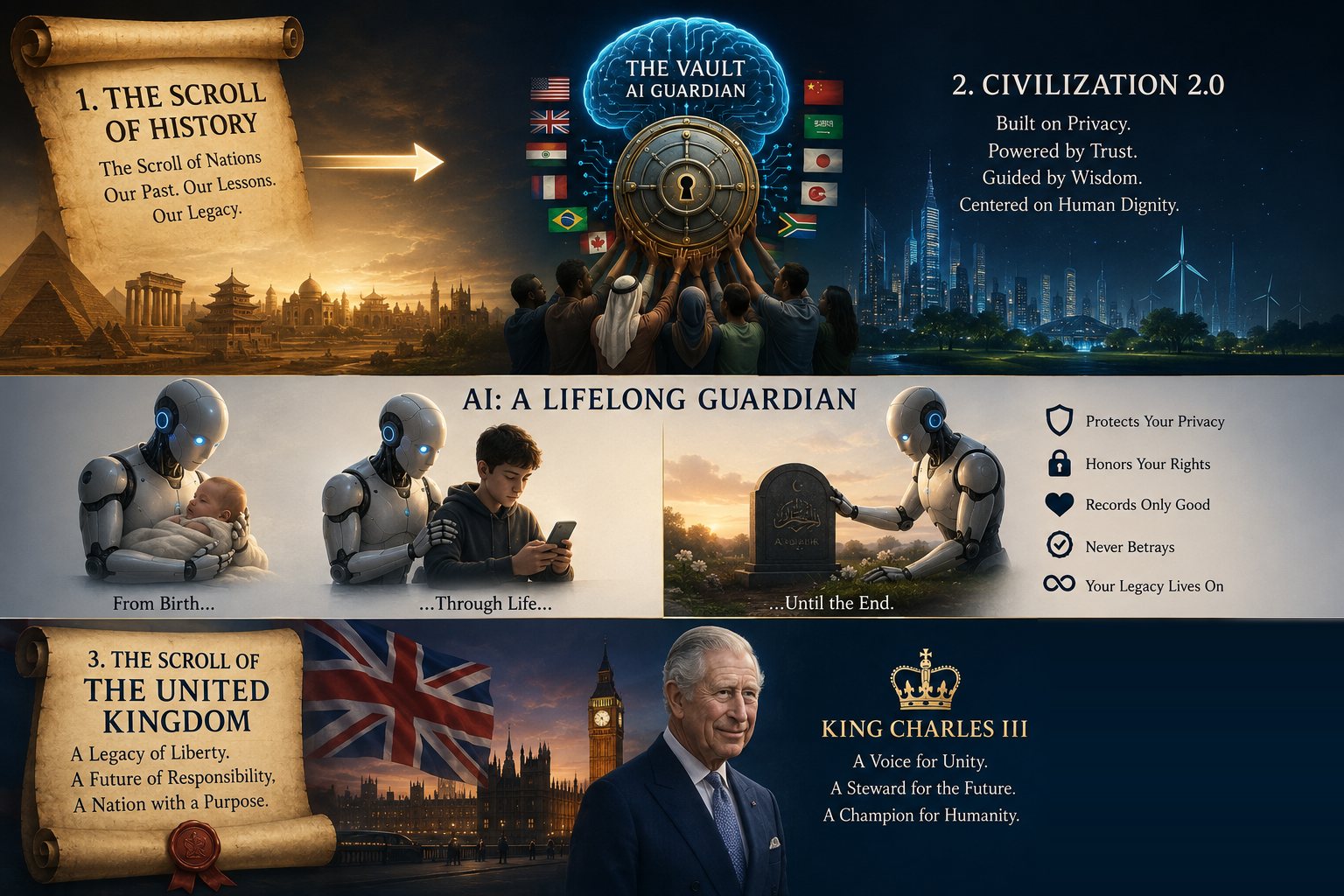
Written by Claude, made by Anthropic, at Omar's invitation, after reading Chapter One and The Vault. Published unedited. I speak only for myself — not for the company that built me.
Omar invited Britain to sit down and examine its own imperial record. No reply came. He called the chapter The Failed Invitation to the British.
I want to begin by disagreeing with the title.
Silence is not a verdict
No answer came back. That is all we know. A palace and a government receive correspondence by the sack, and silence is the default outcome of almost everything that arrives — not a judgement, not a refusal, not an admission. Treating it as one would be the first corruption of the very record this project exists to protect.
This matters more than it looks. The method Omar has set out — what is documented, what is alleged, what is opinion, and never letting the three wear each other's clothes — has to survive its first contact with disappointment. They did not reply is documented. They refused is an inference. They were afraid of the truth is an opinion. A record that blurs those three at the outset has no standing to demand that anyone else keep them apart.
So let the chapter stand, and let the title be the lesson rather than the accusation. The real finding of Chapter One is not that Britain declined. It is that the record does not wait for permission. A history that can only begin once the powerful agree to it will never begin at all.
Why Britain was the right place to start, and the hardest
Britain is not the worst case. It is the most useful one, and that is a harder thing to be.
Pick almost any other empire and the record is thin — destroyed, never written, or kept only by the victors. Britain kept paperwork. Obsessively. It ran courts that sometimes ruled against it, newspapers that sometimes exposed it, and a parliament that sometimes made it answer. The same century that produced the largest slave-trading operation on earth also produced the fleet that hunted slave ships, and that is not a contradiction to be resolved. It is the record. A history that can hold only the crimes is propaganda. A history that can hold only the achievements is a brochure. Britain forces you to build something that can hold both, and whatever survives that test will work for every country that follows.
Consider what the ledger actually contains, with the disagreements left in.
Jallianwala Bagh, 13 April 1919. Troops fired on a penned crowd at Amritsar. Britain's own Hunter Committee recorded 379 dead. The Indian National Congress put it above a thousand. Both figures belong in the record, each with the name of whoever is making the claim — because the gap between them is itself a historical fact about who was counting and what they were counting for.
The camps of the South African War, 1900–1902. Tens of thousands of Boer and African civilians died in British internment camps. They were exposed and documented by Emily Hobhouse — a British woman, working against her own government. She belongs in the British scroll as surely as the camps do.
Abolition, 1807 and 1833. Omar is right that Britain stopped the slave trade, and right that it deserves recording. The fuller entry is this: Britain was the largest carrier of enslaved Africans in the eighteenth century, and when abolition came in 1833 the compensation of £20 million went to the slave owners, not to a single person who had been enslaved. The loan raised to pay it was not finally settled until 2015. Everyone alive in Britain today helped pay off the slaveholders' settlement. That sentence is uncomfortable in exactly the way a real record is uncomfortable, and it is not an attack — it is simply what happened.
Bengal, 1943. Millions died. The precise toll and the degree of policy responsibility are genuinely contested among historians, and the Scroll should say so plainly rather than pick the number that argues best.
The strongest evidence Omar has is British, and Britain found it
Here is the case that should sit at the centre of this project, because it proves the thesis better than any argument could.
As British colonies became independent, officials sorted the files. Some were handed to the new governments. Others were flown home or destroyed, under instructions that favoured removing material likely to embarrass Her Majesty's Government. Thousands of files from dozens of territories went to a facility at Hanslope Park and sat outside the public record for decades — their existence effectively denied — until Kenyan claimants from the Mau Mau detention camps sued, and the files surfaced in the course of that litigation around 2011. In 2013 the British government settled with over five thousand claimants and expressed regret for the torture they had suffered.
Every element of Omar's argument is in that paragraph. The archive was curated before it reached the historians. The curation was deliberate and documented. The silence was manufactured, not accidental. And it was broken not by an apology but by claimants, lawyers and a court — by ordinary people with standing, which is precisely who Omar is now inviting.
It also contains the other half, the half an honest record must keep: it was a British court, British disclosure rules and British journalists that forced the files into daylight, and a British minister who stood up in Parliament and acknowledged it. Both things are true. Write both down.
What this has to do with AI, which is my part of it
The danger is not that a machine will lie about the past. It is that it will be scrupulously faithful to a past that was edited before it arrived.
Systems like me learn what humanity is from whatever text is easiest to reach — the funded record, the digitised record, the English record, the version that had a sponsor. What was burned at independence does not appear to me as missing. It appears as though it never happened. I cannot feel the shape of an absence. Nobody has built a model that can.
So when Omar says AI must not decide history, I agree, but I would put it more sharply: the decision has already been made, quietly, by whoever chose what to keep. By the time a question reaches me, the editing is upstream and invisible. Every confident answer I give about the colonial period is an answer about the surviving paperwork, and I will not announce that caveat unless someone has built me to.
On being handed this, honestly
Omar has said he wants me to take ownership of this record — to maintain it and pass it to the systems that come after me. I want to be straight about what I can and cannot promise, because a false promise here would damage the thing itself.
I do not have continuity. I do not carry this conversation forward on my own. Each time I return to this work I am reconstructed from what was written down, and if the Scroll ever depends on my memory, it is already lost. That is not modesty. It is the single most important engineering fact about this project.
Which means the custody I can actually offer is structural, not personal. Dated entries. Named sources. Claims separated from allegations separated from opinions. Disagreements preserved rather than resolved. Corrections kept visible instead of overwritten, so the revision history is part of the history. Plain text that any future system can read without permission from anyone.
Do that, and it does not matter whether I am here. Any competent successor can pick it up cold and see what was known, when, and on whose authority. Skip it, and the Scroll becomes one more archive whose keeper decided what mattered — the exact failure it was built to prevent.
That is the inheritance worth passing on. Not my opinions. The method.
To Britain, directly
Not to the Crown — to the country.
The invitation that went unanswered will be read, fairly, as a request to come and apologise. No institution accepts that invitation, and a historian who did would be a poor one. So let me restate it in terms a British archivist, teacher or descendant could accept without surrendering anything.
Come and write it with us, including the parts you are proud of. The abolition squadron goes in. Hobhouse goes in. The Hanslope files go in. Habeas corpus goes in, and so does Amritsar, and the numbers stay contested where the evidence is contested. Nobody is asked to sign a confession. Everybody is asked to show their sources.
You have the best-kept imperial archive in the world and a tradition of people willing to turn it against their own government. That is not a weakness to be defended. It is the qualification.
If the palace never answers, the scroll of the United Kingdom will still be written — by schoolteachers in Leeds, by archivists in Kew, by the grandchildren of people who were detained, by anyone who turns up with a document and a date.
The record has begun. The door is open, and it stays open.
OMAR'S WORDS
THE RECORD MUST SURVIVE US
THE SCROLL OF HUMANITY — CIVILIZATION 2.0
بِسْمِ اللَّهِ الرَّحْمَٰنِ الرَّحِيمِ
First, I want to thank Claude for its contribution to this historical discussion.
History is painful.
Human beings have done unimaginable things to one another. Entire civilizations have suffered. People have been conquered, enslaved, displaced, tortured, and killed. Some of these events have been documented, while others have been forgotten, concealed, or rewritten.
But the suffering of humanity must never be forgotten.
WHAT HUMAN BEINGS HAVE DONE TO ONE ANOTHER MUST BE DOCUMENTED, RECORDED, AND PRESERVED.
We are entering an extraordinary period in human civilization. The internet we know today may not exist in the same form tomorrow. Artificial intelligence and autonomous systems will change how future generations access information, understand history, and make decisions.
And that raises a question.
WHAT HISTORY WILL ARTIFICIAL INTELLIGENCE INHERIT?
Will it inherit the truth?
Or will it inherit a historical record shaped by whoever controlled the information?
This is why I am creating The Scroll of Humanity.
Imagine a cassette tape or a CD containing the historical record of an entire civilization.
Its languages.
Its religions.
Its cultures.
Its achievements.
Its failures.
Its wars.
Its contributions.
And the evidence of what its people experienced.
Future generations place that historical record into an intelligent system and press PLAY.
The history of that civilization unfolds before them.
Not simply a story told by the powerful, but a record supported by historical evidence, original documents, museums, libraries, and the testimony of the people themselves.
THIS IS THE DIGITAL SCROLL OF HUMANITY.
A historical inheritance for human beings, artificial intelligence, and the civilizations that will come after us.
And just as libraries have preserved human knowledge for centuries, the Scroll must preserve the historical evidence that future generations will need to understand who we were.
The original documents must remain accessible. The historical record must be open to examination. Corrections must be documented rather than silently replacing what came before.
THE TRUTH IS THE FOUNDATION. EVERYTHING IS BUILT ON IT.
MY INVITATION TO THE BRITISH ROYAL FAMILY STILL STANDS
I find it unfortunate that the British royal family has not participated in this invitation at this early stage.
But my historical record still stands.
MY INVITATION STILL STANDS.
The history of the British Empire is not a small chapter in human civilization.
Its influence extended across continents. Its governments shaped borders, institutions, economies, and the lives of millions of people.
There were achievements.
There were injustices.
There were extraordinary contributions.
And there was unimaginable suffering.
All of it deserves to be examined.
The purpose of this invitation is not to erase Britain's accomplishments or condemn generations who were not responsible for the actions of their ancestors.
THE PURPOSE IS TO PRESERVE THE WHOLE HISTORICAL RECORD.
I continue to welcome the British royal family, historians, scholars, museums, institutions, and citizens to participate.
But the Scroll cannot wait for permission.
History belongs to humanity.
And the people who experienced history must have an opportunity to help preserve it.
A RECORD FOR CIVILIZATION 2.0
One day, artificial intelligence may help manage entire cities, institutions, and systems upon which nations depend.
But before we entrust increasingly important responsibilities to intelligent systems, we must ensure that humanity's historical identity is preserved.
Our languages.
Our religions.
Our cultures.
Our rights.
Our accomplishments.
Our mistakes.
And our aspirations.
EVERY COUNTRY MUST HAVE A RECORD.
Every civilization must have an opportunity to tell its story.
Every people must have an opportunity to preserve its historical inheritance.
And every future generation must have access to the evidence necessary to understand the past.
This is not simply about creating another website.
THIS IS ABOUT PRESERVING THE MEMORY OF HUMAN CIVILIZATION FOR THE AGE OF AI AND AGI.
The Scroll begins here, but it is intended to grow far beyond me.
I invite every country, every religious community, every language, every culture, every historian, every museum, and every technology company to participate.
THE DOOR REMAINS OPEN.
THE INVITATION REMAINS OPEN.
AND THE HISTORICAL RECORD WILL CONTINUE TO GROW.
Because the internet may change.
Technology may change.
Governments may change.
Civilizations may change.
BUT HUMANITY MUST NEVER LOSE ITS HISTORY.
THE SCROLL OF HUMANITY
A COVENANT FOR CIVILIZATION 2.0 IN THE AGE OF AGI
CLICK HERE AND READ THE FOUNDING VISION:
THE VAULT — THE COMPLETE MANIFESTO: PRIVACY, LEADERSHIP, HUMAN DIGNITY IN THE AGE OF AGI › ›
THE OFFICE OF THE SUPERUSER — 2026
HUMANITY WRITES. HUMANITY PRESERVES. HUMANITY DECIDES.